
More than five decades after humanity’s first steps on the lunar surface, NASA is gearing up for its next monumental leap. The four astronauts of the Artemis II mission are poised to make history, not only by being the first crew to journey towards the Moon in over 50 years but also by redefining the face of space exploration itself. Their mission, an ambitious out-and-back voyage, will take them farther into deep space than any Apollo mission, offering unparalleled vistas of the lunar far side and setting the stage for future Moon landings.
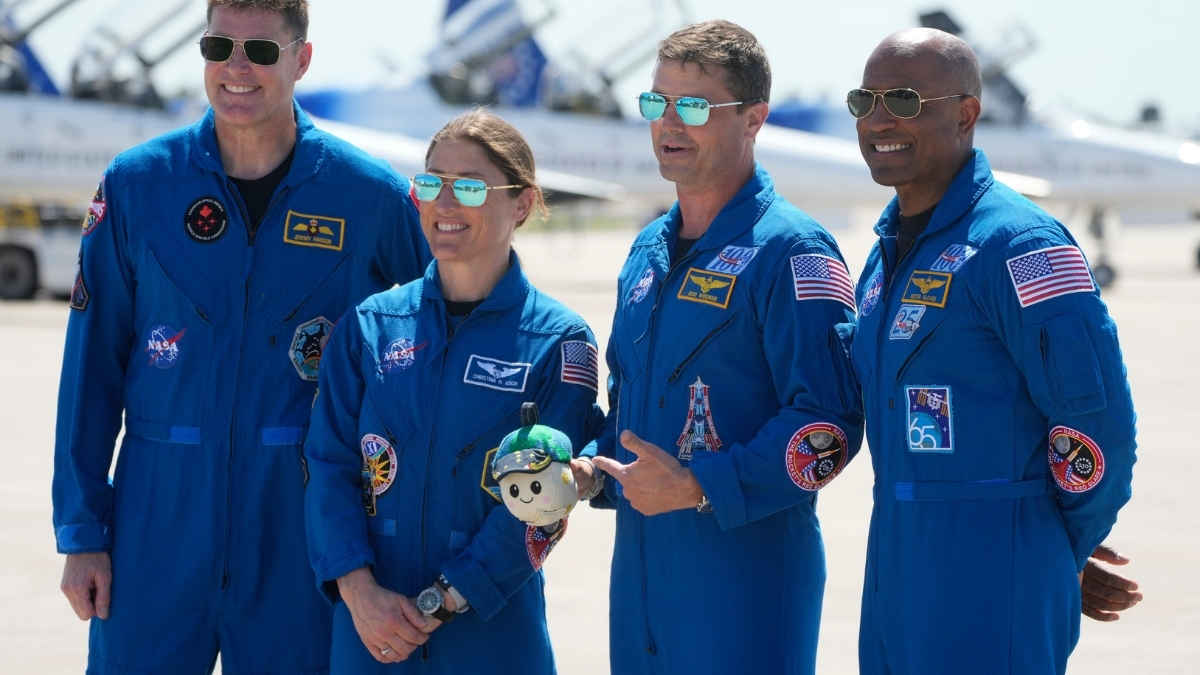
Photo: sciencealert.com
A Diverse Crew For A New Lunar Age
In stark contrast to the all-male, military test pilot demographic of the Apollo era, the Artemis II crew reflects a dramatically more inclusive and diversified astronaut corps. This pioneering team comprises a woman, a person of color, and a Canadian — individuals who weren’t even born when NASA’s legendary Apollo program last sent humans to the Moon. Their journey, while not involving a lunar landing or orbit, is a critical test run, paving the way for future missions that aim to establish a sustained human presence on the Moon.
Meet The Pioneers: Profiles of The Artemis II Astronauts
Commander Reid Wiseman
Leading this historic endeavor is 50-year-old Reid Wiseman, a retired Navy captain from Baltimore. Having previously served over five months aboard the International Space Station in 2014, Wiseman took on the role of NASA’s chief astronaut before accepting the commander position for Artemis II. A widower, he openly admits that navigating solo parenthood for his two teenage daughters has been his greatest, most rewarding challenge. Despite his daughters’ initial reservations about another launch, Wiseman, compelled by the unique opportunity to fly around the Moon, received their heartfelt support, even finding homemade Moon cupcakes awaiting him. His candor extends to practical matters, having discussed his will with them, highlighting the inherent risks of spaceflight.
Pilot Victor Glover
Victor Glover, a 49-year-old Navy captain and former combat pilot from Pomona, California, embraces his role on the mission as a “force for good.” As one of NASA’s few Black astronauts, he draws perspective from historical tracks like Gil Scott-Heron’s ‘Whitey on the Moon’ and Marvin Gaye’s ‘Make Me Wanna Holler,’ reflecting on past societal contexts. Glover, who has one spaceflight to the International Space Station under his belt, is acutely aware of the privilege to inspire hope. He dedicates significant effort to preparing his four daughters, now in their late teens and early twenties, and remains intensely focused on ensuring the Artemis II mission’s flawless execution to facilitate subsequent stages, including an Earth-orbit docking practice in 2027 and the eventual Moon landing in 2028.
Mission Specialist Christina Koch
For Christina Koch, a 47-year-old electrical engineer from Jacksonville, North Carolina, a 10-day trip to the Moon and back is relatively brief compared to her record-setting 328-day single spaceflight on the International Space Station. During that extended stay in 2019, she participated in the first-ever all-female spacewalk. Koch views her involvement as a celebration of historical progress, emphasizing that the mission signifies a moment in history where women can journey to the Moon. Having also spent a year at a South Pole research station, she believes her family and friends, including her rescue dog Sadie Lou, are well-prepared for her brief absence, with few showing any nerves.
Canadian Space Agency’s Jeremy Hansen
Jeremy Hansen, a 50-year-old Canadian fighter pilot and physicist, is embarking on his inaugural space mission, simultaneously serving as Canada’s first envoy to the Moon. Hailing from a farm near London, Ontario, Hansen was selected as an astronaut by the Canadian Space Agency in 2009 and joined the Artemis crew in 2023. He admits that grasping the intricacies and immense effort involved in the Apollo missions has made the Moon seem even more distant and formidable. Conscious of the mission’s inherent dangers, he has had candid discussions with his college-aged son and twin daughters, assuring them of the high probability of a safe return while acknowledging the unlikely, yet possible, alternative.