A remarkable fossil discovery is offering unprecedented insight into the violent interactions of the late Cretaceous period. Researchers have uncovered a rare Edmontosaurus skull bearing a broken Tyrannosaurus tooth embedded within its facial bones, capturing a chilling moment of prehistoric predator-prey dynamics. This unique specimen provides direct evidence that could redefine our understanding of how the iconic Tyrannosaurus rex hunted and fed.
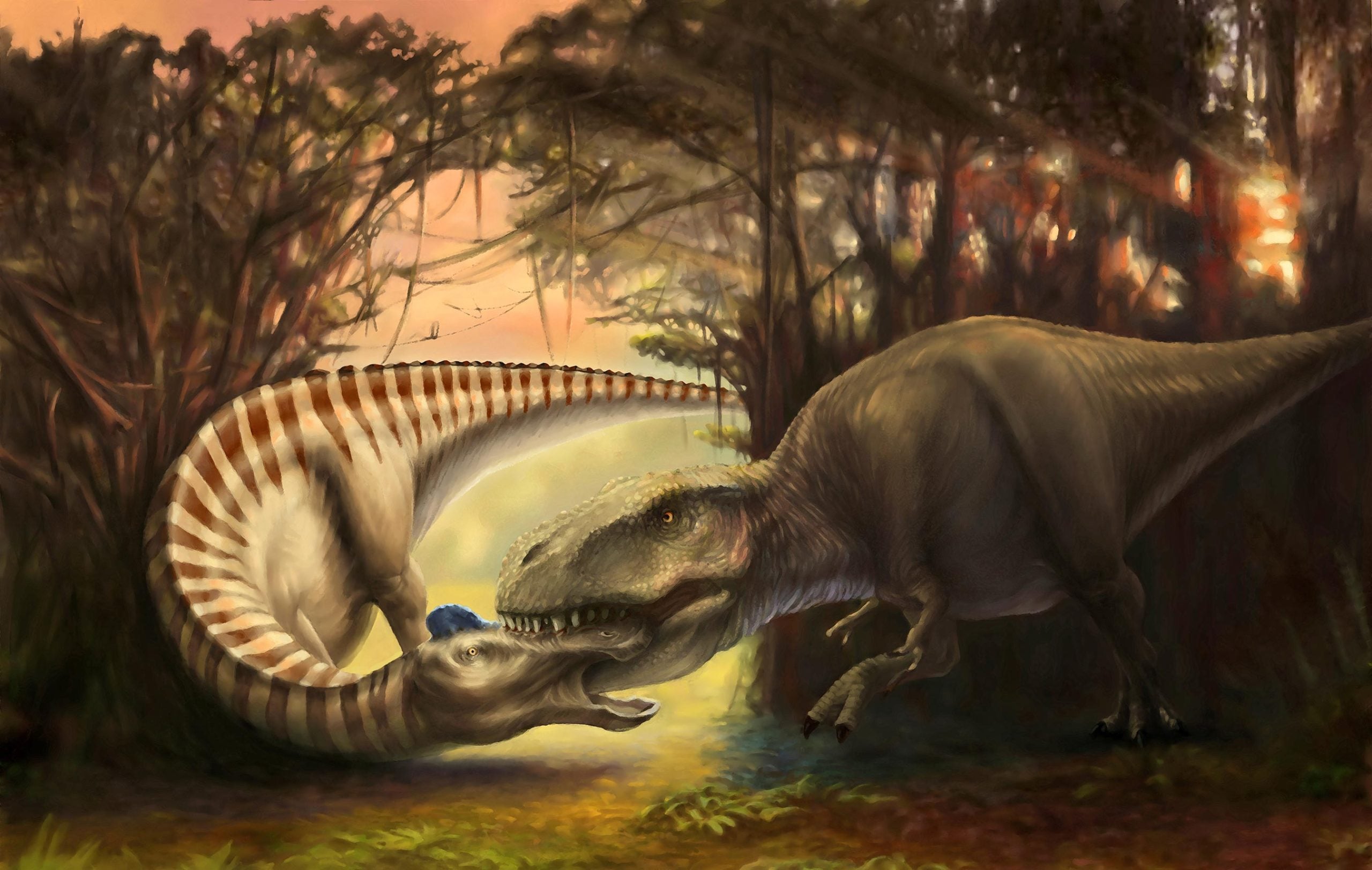
Photo: scitechdaily.com
Unearthing a Direct Encounter
Discovered in Montana’s rich Hell Creek Formation in 2005, the nearly complete Edmontosaurus skull now housed at Montana State University’s Museum of the Rockies presents an extraordinary archaeological find. Unlike typical fossilized bite marks, which only suggest a predator’s presence, the embedded tooth offers definitive proof of a direct, forceful interaction. This artifact provides a literal snapshot from approximately 66 million years ago, a time when Tyrannosaurus reigned supreme among predators, sharing its environment with large herbivores such as Triceratops and Edmontosaurus, shortly before the extinction event that ended the Age of Dinosaurs.
The significance of this discovery prompted a collaborative study involving Taia Wyenberg-Henzler from the University of Alberta and John Scannella, Curator of Paleontology at the Museum of the Rockies. Their detailed findings, published in the journal PeerJ, emphasize the rarity and evidential value of such a find. Wyenberg-Henzler likened the research process to investigating an ancient crime scene, where the embedded tooth unequivocally identifies both the victim and the aggressor, allowing scientists to reconstruct the sequence of events with remarkable clarity.
Advanced Analysis Confirms Lethal Force
To positively identify the predator, researchers meticulously compared the embedded tooth to those of all known carnivores from the Hell Creek Formation. The analysis conclusively linked it to a Tyrannosaurus. Further enhancing their investigation, high-resolution CT scans performed at Advanced Medical Imaging at Bozeman Health Deaconess Hospital provided intricate details about how the tooth became lodged in the Edmontosaurus’s bone structure. These scans were crucial in understanding the biomechanics of the ancient struggle.
Scannella highlighted the thrill of uncovering a fossil that encapsulates specific behavior: a Tyrannosaurus biting into the face of a duck-billed dinosaur. The absence of healing around the embedded tooth indicates that the Edmontosaurus likely did not survive the attack. It suggests a scenario where the animal was either already deceased at the time of the bite or succumbed directly as a result of the trauma. Wyenberg-Henzler further elaborated that the tooth’s position in the Edmontosaurus’s nose implies a direct, face-to-face confrontation, characteristic of a predatory kill. The substantial force required to break a tooth off within bone further underscores the deadly intent and power behind the strike, painting a vivid and terrifying picture of the Edmontosaurus’s final moments.
New Perspectives on Prehistoric Predation
For decades, paleontologists have engaged in extensive debates regarding the precise hunting and feeding strategies employed by Tyrannosaurus. This newly analyzed fossil, with its undeniable evidence of an embedded tooth, contributes significant new data to this ongoing discussion. As Scannella noted, it offers critical insights that help to clarify the predatory behaviors of one of Earth’s most formidable ancient creatures.