
In a momentous decision, the United Nations General Assembly has officially recognized the enslavement of Africans during the transatlantic slave trade as “the gravest crime against humanity.” This significant resolution, championed by Ghana, is viewed by advocates as a crucial step towards fostering healing and achieving justice for the profound historical wrongs committed.
Calls for Apology and Reparatory Justice
The resolution, proposed by Ghana, not only assigned this stark designation but also implored UN member states to contemplate issuing formal apologies for their roles in the slave trade and to contribute to a dedicated reparations fund. While the resolution does not specify a monetary figure for these contributions, it underscores the need for tangible forms of reparatory justice.
The proposal garnered substantial international support, passing with 123 votes in favor. However, it faced opposition from three nations: the United States, Israel, and Argentina. An additional 52 countries, including the United Kingdom and several European Union member states, chose to abstain from the vote. Nations like the UK have historically resisted calls for reparations, asserting that contemporary institutions cannot be held accountable for injustices perpetrated in the past.
Unlike resolutions passed by the UN Security Council, General Assembly resolutions are not legally binding. Nevertheless, they hold considerable moral and political weight, reflecting the consensus of global opinion. Ghana’s President John Mahama addressed the assembly prior to the vote, stating, “Let it be recorded that when history beckoned, we did what was right for the memory of the millions who suffered the indignity of the slave trade and those who continue to suffer racial discrimination.” He emphasized that the resolution serves as a vital guard against historical amnesia and addresses the enduring repercussions of slavery. Ghana’s Foreign Minister, Samuel Okudzeto Ablakwa, clarified that African leaders are seeking justice for victims and support for initiatives such as educational and endowment funds, rather than financial gain for themselves.
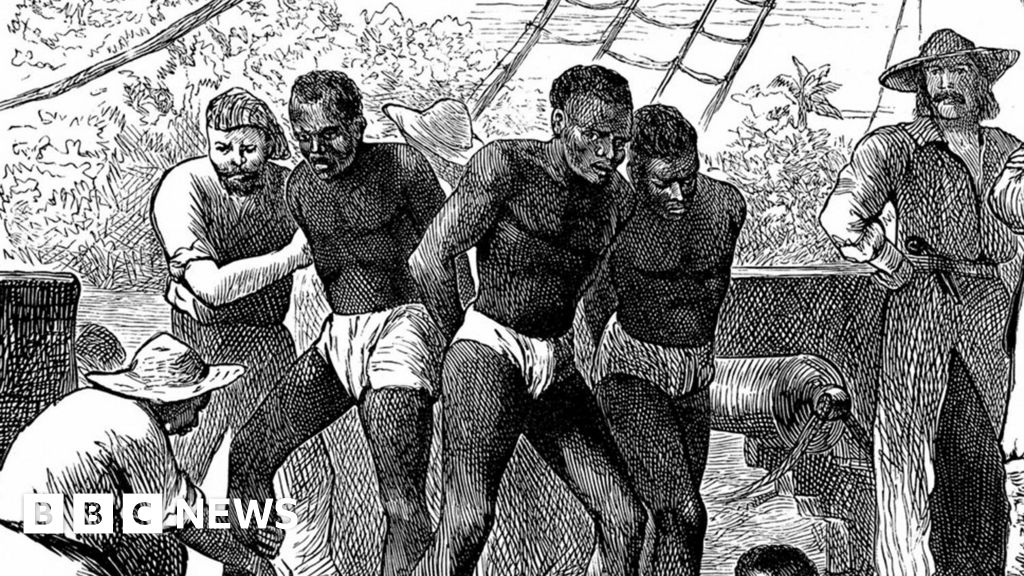
Photo: bbc.com
Global Dialogue and Divergent Stances
The movement for reparations has seen a significant surge in recent years. “Reparatory justice” is the African Union’s designated theme for 2025, and Commonwealth leaders have collectively advocated for constructive dialogue on the subject. Minister Ablakwa reiterated that Ghana’s aim is not to prioritize one form of suffering over another but to document an undeniable historical fact.
Historically, between 1500 and 1800, an estimated 12 to 15 million Africans were forcibly captured and transported across the Atlantic to the Americas, where they were subjected to enslavement. Tragically, over two million people are believed to have perished during these brutal voyages. The adopted resolution, which is backed by both the African Union and the Caribbean Community, explicitly links the lingering effects of slavery to contemporary racial inequalities and underdevelopment experienced by people of African descent globally. Ablakwa highlighted how “many generations continue to suffer the exclusion, the racism because of the transatlantic slave trade.”
Despite acknowledging the “untold harm and misery” inflicted by the transatlantic slave trade, the UK’s ambassador to the UN, James Kariuki, raised concerns about the resolution’s specific wording and its implications under international law. He argued that “no single set of atrocities should be regarded as more or less significant than another.”
Similarly, the U.S. ambassador, Dan Negrea, articulated his country’s objection, stating that the U.S. “does not recognise a legal right to reparations for historical wrongs that were not illegal under international law at the time they occurred.” He also expressed disapproval of what he termed the “cynical usage of historical wrongs as a leverage point to reallocate modern resources.” Negrea further defended President Trump’s administration, asserting that it had done “more for black Americans than any other president,” despite earlier criticisms from President Mahama regarding policies that could “normalize the erasure of black history.”
Ghana’s Enduring Advocacy and Cultural Restitution
As a key hub of the transatlantic slave trade, with numerous historical slave forts still standing along its coastline, Ghana has long been at the forefront of the reparations movement. The resolution further calls for the repatriation of cultural artifacts plundered during the colonial era to their countries of origin. Ablakwa emphasized the importance of these returns, stating, “We want a return of all those looted artefacts, which represent our heritage, our culture and our spiritual significance.”