A staggering quantity of chocolate bars, specifically over 413,000 KitKat units, mysteriously disappeared last week while in transit from Italy to Poland. The colossal shipment, weighing approximately 12 tons, never reached its intended European distribution points, primarily ahead of the crucial Easter selling season. This bizarre incident has quickly become one of the most talked-about consumer goods stories of the year.
Nestlé Confirms Disappearance and Warns of Illicit Sales
Swiss food conglomerate Nestlé, the maker of the popular KitKat brand, officially acknowledged the theft, stating that “the vehicle and its load are still nowhere to be found.” The company expressed concern that the stolen confectionery could surface through unofficial retail channels across the continent. To combat this, Nestlé highlighted that each bar carries unique batch codes, allowing for traceability. Should these codes appear in unauthorized sales, the company urges the public and authorities to be notified.
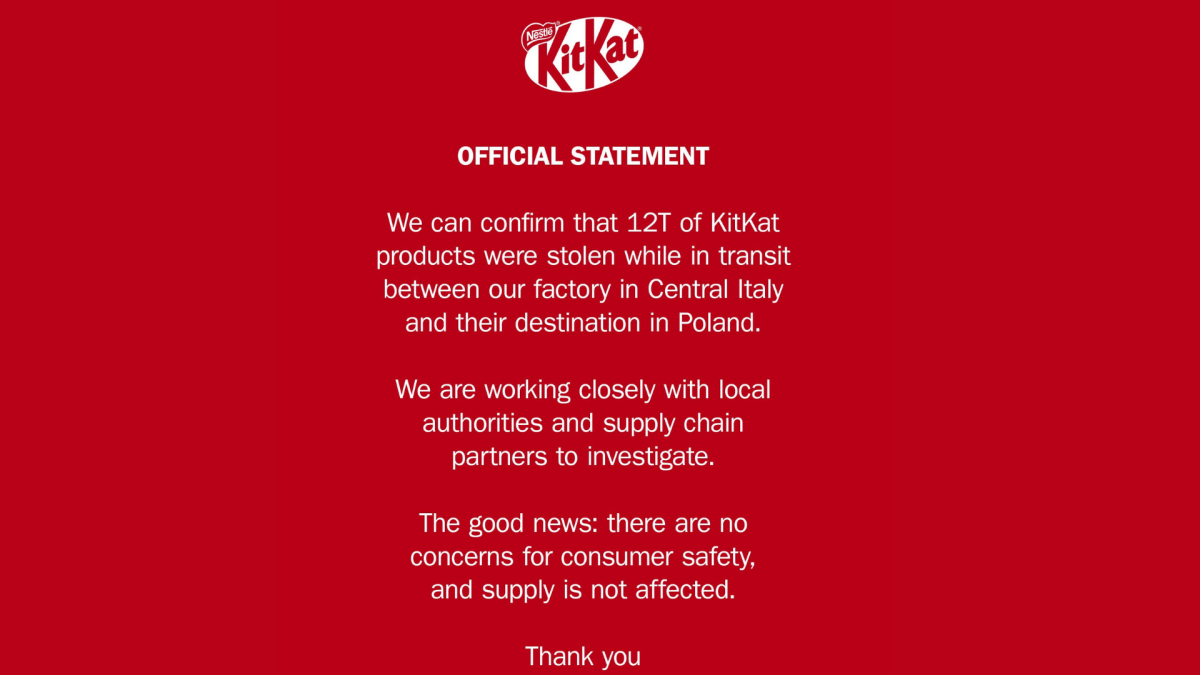
Photo: thestreet.com
While acknowledging the peculiar nature of the crime, Nestlé also used the opportunity to draw attention to a more serious underlying issue. In a statement, the brand light-heartedly remarked on the thieves’ “exceptional taste” but quickly pivoted to emphasize that “cargo theft is an escalating issue for businesses of all sizes.” The company explicitly stated its decision to go public with its experience aims to “raise awareness of an increasingly common criminal trend,” especially given the deployment of “more sophisticated schemes.”
Europe’s Escalating Cargo Crime Wave
Beyond the headline-grabbing nature of the stolen chocolate, this incident underscores a significant and growing problem across Europe: cargo theft. Recent data from TAPA EMEA and the European Parliament reveal an alarming surge, with over 50,000 incidents reported in 2023 alone, leading to estimated annual losses totaling $8.9 billion. Trucks remain the primary target for these criminal operations, accounting for 75% of all reported thefts, a trend driven by organized, large-scale schemes that are projected to continue increasing through 2024 and 2025.
The sheer scale of the KitKat disappearance—an entire truckload comprising hundreds of thousands of units of a globally recognized brand—highlights the sophisticated nature of these operations. The timing, just weeks before Easter, a peak period for chocolate consumption, further amplifies the financial implications and disruptive impact of such a major loss.
Digital Speculation: A KitKat Meme Coin Takes Off
In an unusual turn, the news of the KitKat heist coincided with a speculative surge in a Solana-based meme coin also named “KitKat.” Data from Dexscreener showed a dramatic spike in the token’s value, with an increase of approximately 2,121% over 24 hours, 2,303% over six hours, and 203% in a single hour. The token, boasting a market cap of around $43,000 and nearly $92,000 in trading volume, saw over 1,800 transactions.
The meme coin’s descriptive page noted its “Community Takeover” status and stated, “This is the OG Kitkat coin Kitkat is a hot topic all over the world after 12T of kitkat were stolen.” It is crucial to note that this digital asset has no affiliation whatsoever with Nestlé or the actual stolen chocolate shipment. Its meteoric rise appears to be purely a phenomenon of short-term hype, leveraging a trending global news story. As with all meme coins, this highly speculative asset is subject to extreme volatility, and investors face a substantial risk of capital loss.