Elon Musk recently intensified speculation regarding Tesla’s next major vehicle, suggesting it will cater specifically to growing families. Following his earlier hint about a vehicle “way cooler than a minivan,” the CEO has now provided further clues indicating a revolutionary three-row SUV is actively under development.
Discussions on social media platform X veered into academic territory when users drew Musk’s attention to a study titled “Car Seats as Contraception.” This research posits that the common inability of most vehicles to accommodate three child seats in the rear might lead many families to limit their number of children to two. When a user suggested that a genuine three-row Tesla could potentially spark a baby boom, Musk’s concise reply was, “Well, I guess we should solve this.”
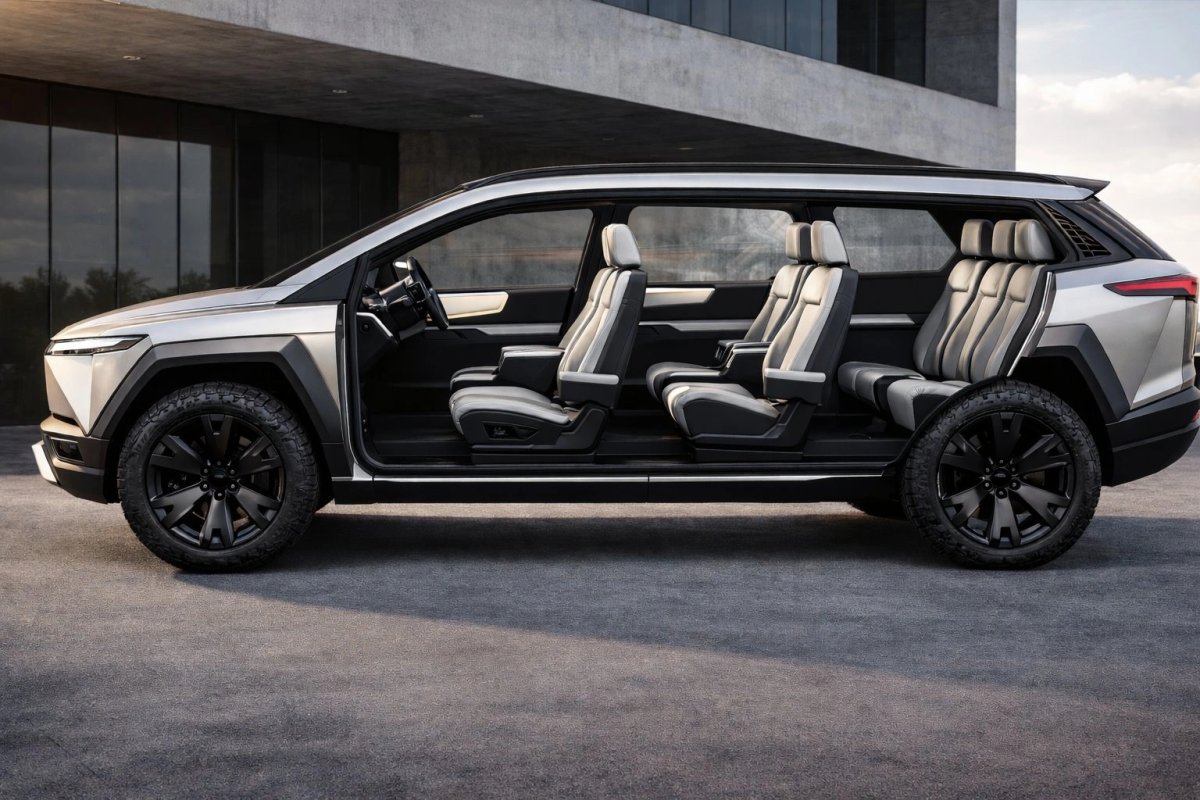
Photo: notateslaapp.com
Designing for the Modern Family
One particularly intriguing exchange occurred when a follower proposed that a three-row vehicle should feature a dedicated pair of doors for each row, streamlining access and eliminating the need for passengers to maneuver awkwardly. Musk simply responded, “Noted.”
While a six-door production vehicle seems improbable for the mass market, this interaction hints at an innovative entry system. Potential solutions could include an expansive, minivan-style sliding door or an evolved iteration of the Model X’s distinctive falcon-wing doors. Enthusiasts have already begun conceptualizing a “CyberSUV,” envisioning a vehicle that retains the Cybertruck’s robust, stainless-steel aesthetic but replaces its open bed with a fully enclosed, three-row cabin.
The Cybertruck Platform Advantage
The timing aligns with Tesla’s strategy to discontinue production of the Model S and Model X, making way for its advancements in robotics. This move, however, leaves a notable void in the North American market for a large, premium family vehicle. While the Model Y L, a six-seat variant, is becoming available in international markets after its initial exclusivity in China, Musk has been clear that its arrival in the U.S. remains uncertain, potentially not until late 2026, if at all.
This delay for the Model Y L becomes logical if Tesla is indeed planning a purpose-built “CyberSUV” leveraging the Cybertruck platform. A vehicle built on this foundation would benefit from a 48-volt electrical architecture, steer-by-wire technology, and sufficient width to comfortably install three child seats in the second row—a challenge for the narrower Model Y. Furthermore, it would utilize the existing Cybertruck assembly line at Giga Texas, which possesses ample capacity to support a new high-volume SUV alongside the pickup.
Meeting Market Demand
Musk further underscored the target demographic by reposting content highlighting the need for “businessdads” to accommodate their families in three-row vehicles. This signals Tesla’s ambition to compete in the luxury SUV segment currently dominated by models like the Cadillac Escalade IQ and Rivian R1S. Tesla’s chief designer, Franz von Holzhausen, previously advised fans to “wait and see” regarding a potential CyberSUV. With images of a larger SUV having appeared in the background of recent Cybercab videos, the vision for this new family hauler is steadily coming into focus.
As the Cybercab robotaxi is slated to begin mass production soon, Tesla’s strategic focus appears to be shifting towards specialized vehicles. A seven-seater, stainless-steel “CyberSUV,” designed as a resilient mobile sanctuary for large families, represents a logical and quintessentially “Musk” progression for the company.
Farewell to a Pioneer: Tesla Model S Production Nears Its End After 17 Years
The Tesla Model S is marking its 17th anniversary this week, but the milestone arrives with a bittersweet note. As the vehicle that undeniably revolutionized perceptions of electric cars, proving they could be stylish, high-performing, and practical, it is now approaching its curtain call. With production scheduled to cease in the second quarter of 2026, the automotive world is preparing to bid farewell to an undeniable icon.
First unveiled by Elon Musk on March 26, 2009, in Hawthorne, California, the Model S represented a radical departure from the small, niche electric vehicles prevalent at the time. Even then-California Governor Arnold Schwarzenegger was present to witness what would become the foundational blueprint for the modern electric automobile.
A Legacy of Innovation
Upon its debut in 2012, the Model S didn’t just compete within the EV sector; it significantly outperformed luxury internal combustion engine vehicles. In 2013, the Model S earned MotorTrend’s Car of the Year award by a unanimous vote, an unprecedented achievement as the first non-combustion engine car to receive the accolade in the award’s 64-year history.
The accolades continued to pour in. Consumer Reports famously awarded the 2012 Model S an exceptional score of 99 out of 100, then the highest rating ever given to a vehicle. Testers were consistently impressed by its “invigorating performance” and “world-class” handling. TIME Magazine further solidified its historical significance by listing the 2012 Model S among the top inventions of the past 25 years, placing it alongside groundbreaking innovations like the iPhone and the Mars Rover.
Enduring Design, Evolving Technology
Remarkably, the Model S has maintained much of its original exterior design throughout its 17-year run. While most vehicles undergo multiple complete body redesigns over such a period, the Model S largely retained its 2012 silhouette, save for minor updates to bumpers and headlights. Tesla’s strategy focused on continuous internal iteration, consistently upgrading motors, battery chemistry, and computing hardware while preserving a timeless exterior aesthetic.
Early units, often regarded as “beta” products, faced criticism for issues like panel gaps and interior fit-and-finish as Tesla established itself as a legitimate automaker. However, the 2021 Plaid refresh transformed it into a hypercar contender, shattering performance records with a sub-2-second 0–60 mph acceleration time. It even ventured into becoming a “gaming console on wheels” with its dedicated GPU, although this feature was later reevaluated.
Shifting Priorities for Tesla’s Future
The discontinuation of the Model S stems from Tesla’s broader strategic pivot towards artificial intelligence and robotics. The Fremont factory production lines currently dedicated to the Model S are scheduled for retooling this summer to facilitate the manufacturing of the Optimus humanoid robot.
With Musk recently teasing an entirely new vehicle—likely a larger SUV targeting families—and the next-generation Roadster poised to assume the role of Tesla’s high-end performance flagship, the Model S no longer fits into the company’s evolving product roadmap. Its retirement represents an honorable discharge for a vehicle that undeniably reshaped the automotive landscape, leaving a profound legacy to which every modern electric vehicle owes a debt of gratitude.
Full Self-Driving Set for Israeli Debut, Minister Confirms
Tesla’s Full Self-Driving (FSD) software is on the cusp of a significant expansion into the Middle East. After several months of rigorous regulatory assessments and persistent advocacy from local Tesla owners, Israel’s Minister of Transport, Miri Regev, has all but confirmed that the advanced driver-assistance technology is nearing its final approval stage.
The confirmation arrived via a succinct yet impactful response on X. Following Elon Musk’s post of a video showcasing FSD’s adept navigation through a congested street, deftly handling a parked truck and oncoming traffic, Minister Regev’s two-word reply — “Coming soon…” — signaled the imminent launch.
A Push from the Community
This development marks a substantial victory for Israel’s dedicated Tesla community. Local owners have actively campaigned for FSD approval for an extended period, even organizing a petition that garnered over 1,000 verified signatures. The group’s argument centered on the potential of the software, already operational in regions like the U.S., Canada, Mexico, China, Australia, New Zealand, and South Korea, to notably enhance road safety in a country characterized by its dense traffic.
Minister Regev’s proactive stance suggests a recognition within the Israeli government of autonomous technology’s potential to reduce accidents. Tesla has already established a strong presence in the “startup nation,” having officially entered the market in 2021 and integrating Hebrew language support by 2023. Given that many Teslas in Israel are newer models equipped with Hardware 4 (HW4), a significant portion of the vehicles on the road are already physically capable of running the latest FSD versions.
Strategic Expansion and Data Collection
Israel is now engaged in a friendly competition with European nations to see which will be the next to join the FSD club. While the Netherlands is anticipating a landmark approval next month, which would pave the way for wider rollout across the European Union, Israel’s smaller, technologically forward market could potentially achieve a comprehensive launch sooner.
Tesla’s ongoing progression towards unsupervised FSD makes adding Israel to its operational map crucial. This expansion will provide the company with invaluable data on unique Middle Eastern driving scenarios, essential for training its neural networks to effectively navigate local infrastructure and driving customs, much like the company adapted for Australia’s distinctive “hook turns.”
Anticipating the FSD Rollout
Based on Tesla’s rollout patterns in other international markets, the software is expected to be offered as a one-time purchase, potentially around 25,000 ILS (approximately $8,000 USD), or through a monthly subscription of about 300 ILS (roughly $99 USD). However, with Tesla having discontinued one-time FSD purchases in North America, there is a possibility that Israel may only see FSD introduced as a subscription service. The launch is also likely to be staggered, with Hardware 4 owners gaining initial access to ensure optimal system calibration for Israeli roads.
Given Elon Musk’s recent confirmation that FSD v14.3 is currently undergoing testing, Israeli owners might even bypass earlier versions and directly receive the latest iteration of the software. As the Minister’s “Coming soon” indicates, the activation of autonomous driving capabilities for Israeli Tesla owners appears to be mere weeks away.