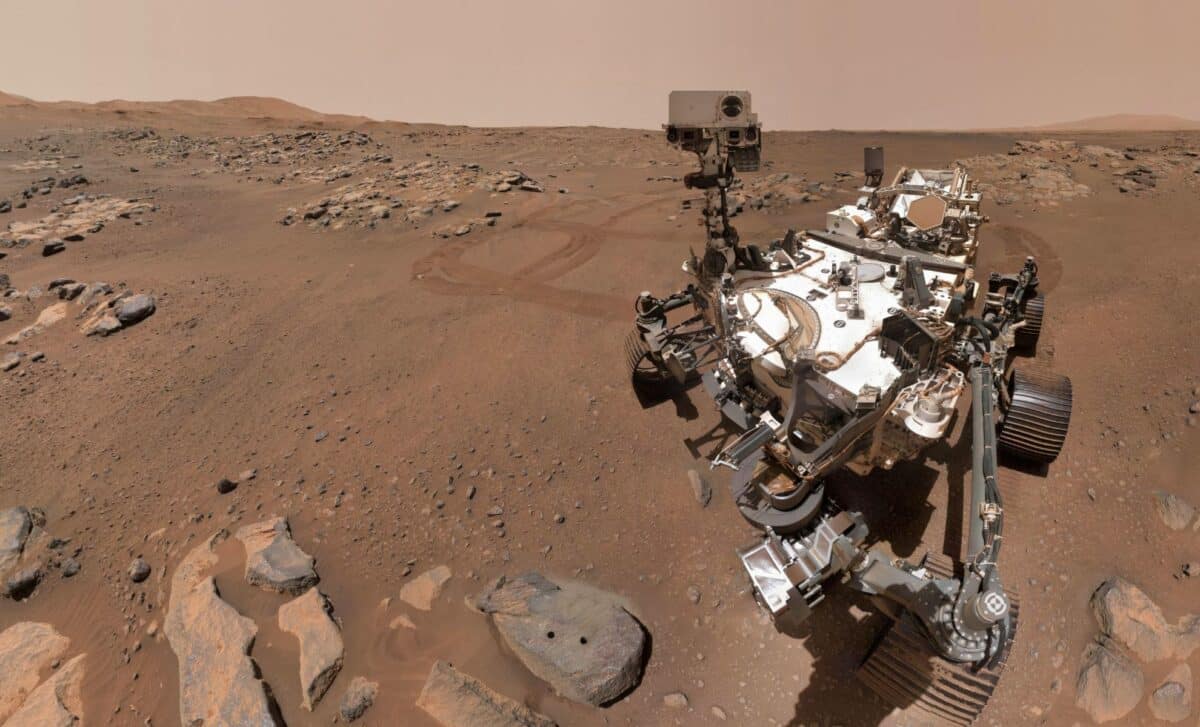
A recent examination of images transmitted by NASA’s Mars rovers has unveiled intriguing possibilities regarding the potential for extraterrestrial life on the Red Planet. Professor William Romoser of Ohio University has put forward observations suggesting the presence of creatures resembling both insects and reptiles.
For an extended period, the scientific community has deployed Mars rovers with the primary objective of detecting past or present life, largely concentrating on identifying chemical signatures or microbial fossils. However, Romoser’s analysis offers a divergent perspective: that Mars might host more advanced, Earth-like organisms. His study, leveraging visuals from the Curiosity rover, indicates that certain geological formations and anomalies within these photographs bear a striking resemblance to terrestrial arthropods and reptiles.
Revealing Putative Martian Arthropods
Professor Romoser’s investigation predominantly utilized images from NASA’s Curiosity rover, where he asserts the identification of several insect-like entities, both airborne and stationary. These organisms, which Romoser likens to ‘bees,’ reportedly exhibit characteristics akin to Earth’s insects, including segmented body structures, wings, and articulated limbs. One particular finding highlights a creature engaged in an acrobatic flight, executing a steep dive before leveling out, much like an insect found on our home planet.
“The ‘bees’ appear to vary in size and type. Several characteristic insect/arthropod anatomical features were identifiable, not all on the same individual, but as a mosaic among individuals,” Romoser noted. The anatomical features observed, such as what appear to be compound eyes and specialized legs, align with the general description of arthropods. Furthermore, Romoser’s findings suggest that these insect-like creatures might be utilizing caves, subsurface burrows, and specific structures for shelter or nesting.
Evidence of Reptilian Forms on the Red Planet
Beyond arthropod-like figures, Romoser’s analysis also revealed what he interprets as fossilized reptile-like specimens within the rover imagery. A notable example he cites resembles an Eastern King Snake, exhibiting a distinct head and symmetrically arranged structures. This purported fossilized entity appears to possess a large, gape-capable mouth, reinforcing the hypothesis that reptile-like life forms could have existed, or may still exist, on Mars.
The observed reptile-like structures display symmetry and anatomical attributes that draw parallels to Earth’s reptilian species. These compelling observations have led Romoser to propose that Mars could have supported, or continues to support, life forms strikingly similar to those found on Earth. In some instances captured in the images, these reptile-like creatures seemingly engage in predatory behavior towards the insect-like organisms.
Expanding the Horizons of Astrobiology
The implications of Professor Romoser’s research extend beyond merely identifying these potential life forms; he suggests that his findings could inaugurate entirely new avenues of scientific inquiry. “Given evidence for the presence of insect/arthropod and reptile-like organisms beyond the confines of Earth, perhaps ‘astroentomology’ and ‘astroherpetology’ will emerge as important topics within the field of astrobiology,” he posited.
Romoser’s initial presentation of these discoveries in 2019 at the National Meeting of the Entomological Society of America ignited a blend of interest and skepticism within the scientific community. Regardless of the eventual consensus, his detailed analysis is undoubtedly set to fuel ongoing discussions about the nature of life on Mars and the provocative possibility of uncovering not just microbial traces, but more complex, multicellular organisms beyond our home world.