A groundbreaking study has revealed the presence of a colossal freshwater reservoir concealed beneath the Great Salt Lake in Utah, a body of water renowned for its high salinity. This significant discovery could have profound implications for water resource management and environmental strategies in the region.
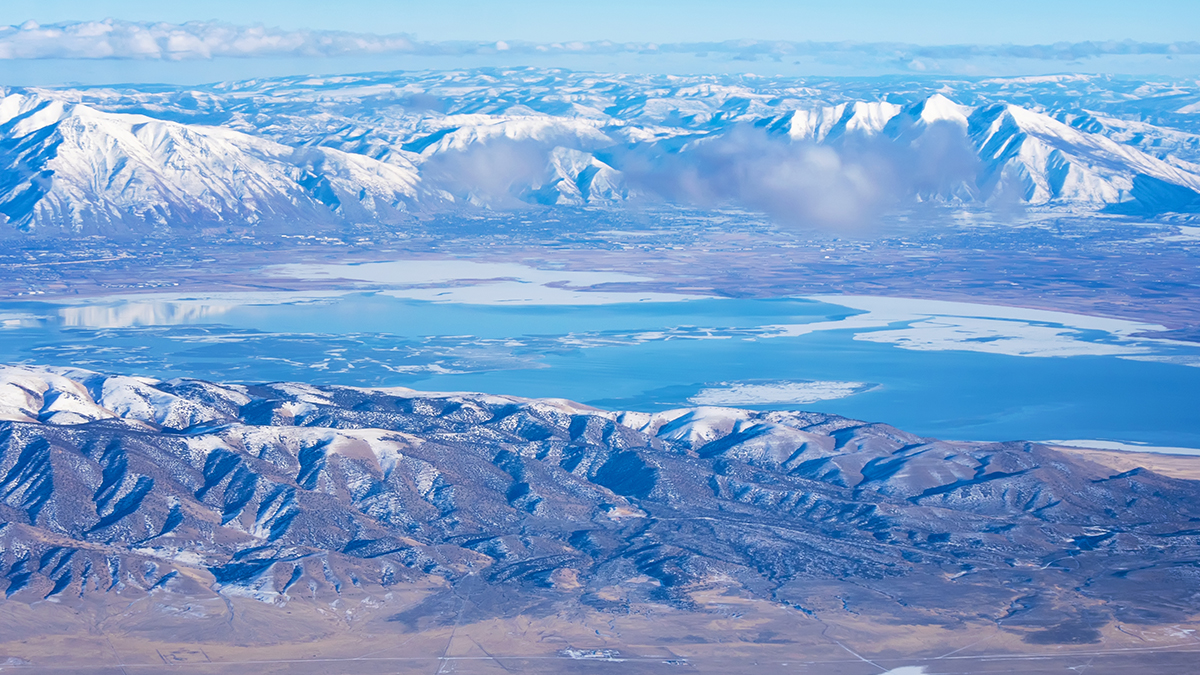
Photo: sciencealert.com
Uncovering the Hidden Depths
Researchers from the University of Utah embarked on an ambitious airborne electromagnetic (AEM) survey, deploying a helicopter equipped with specialized scanning technology over a section of the lake, specifically targeting the Farmington Bay area along its southeastern margin. The AEM technique is instrumental in detecting electrical conductivity, allowing scientists to differentiate between freshwater and saltwater, while simultaneously providing insights into the composition of underlying rock structures.
This advanced method enabled the team to map the location and depth of freshwater deposits. Their findings indicate a sudden and substantial drop in the bedrock beneath the surveyed area of the Great Salt Lake, creating an enormous subterranean space. This vast basin, filled with sand and silt, appears to be thoroughly saturated with freshwater.
Geophysicist Michael Zhdanov highlighted the significance of their detailed mapping efforts. “We were able to answer the question of how deep this potential reservoir is, and what its spatial extent is beneath the eastern lake margin,” Zhdanov stated. “If you know how deep, you know how wide, you know the porous space, you can calculate the potential freshwater volume.”
A Vast and Promising Resource
Early estimates suggest that this newly identified freshwater body could extend to depths of between 3 and 4 kilometers (up to nearly 2.5 miles) in the explored region. While the existence of freshwater beneath the Great Salt Lake had been previously theorized, partly due to the appearance of reed-covered islands across the basin, this study marks the first comprehensive attempt to quantify its potential scale. The sheer extent of the reservoir, particularly how far the sediment-holding bedrock basin stretched into the Farmington Bay playa, came as a surprise to the research team.
Although some freshwater intrusion is expected at the lake’s margins, originating from surrounding mountainous runoff, the survey data suggests a far more extensive presence. This subterranean resource could potentially span the entire 2,500 square kilometers (950 square miles) of the lake’s extent. Hydrologist Bill Johnson commented on the unexpected scope, noting, “It’s that the freshwater underneath it extends so far in towards the interior of the lake and possibly under the entire lake. We don’t know.”
{{IMAGE_2}}
This discovery holds significant promise, especially as the Great Salt Lake continues to diminish due to evaporation. The receding waters have exacerbated the problem of airborne dust, which carries toxic metals into urban areas, posing a considerable public health risk. The newfound freshwater could potentially be used to dampen these dust hotspots, mitigating their environmental impact.
However, researchers caution that a thorough understanding of the groundwater system’s beneficial effects is crucial before any large-scale extraction. “A first-order objective is to understand whether we could use this freshwater to wet dust hotspots and douse them in a meaningful way without perturbing the freshwater system too much,” Johnson added.
Future Research and Global Implications
The research team is actively seeking funding to expand the AEM survey across the entire Great Salt Lake. This broader investigation would precisely chart the boundaries of the bedrock’s sudden drop, providing a more accurate estimation of the total freshwater volume available. Such comprehensive data would be invaluable for future water resource planning in Utah and could also offer insights into similar endorheic lakes globally that might harbor hidden freshwater reserves.
The techniques employed in this study, combining magnetic readings to determine rock depths with electrical conductivity measurements for freshwater mapping, could be replicated in other locations. As Zhdanov emphasized, “This is why we need to survey the entire Great Salt Lake. Then we’ll know the top and the bottom.” The findings of this pioneering research have been published in the journal *Scientific Reports*.
{{IMAGE_3}}